


You are here
From actions to results: HEI’s accountability studies
2025
Understanding whether actions designed to improve the environment and also benefit public health is key to shaping future progress and decisions. These actions often include regulations, policies, interventions, technological advancements, and other planned or unplanned events. As new actions to enhance environmental quality emerge, research that helps understand the potential effects on health will be essential. For 23 years, HEI has led efforts to examine whether actions designed to improve air quality deliver public health benefits through its accountability research.
Why does HEI invest in accountability research?
Accountability studies are the closest equivalent to controlled experimental studies that can be achieved using real-world observations. Therefore, they can show whether the results of the action occurred as expected and whether the intended decreased emissions of pollutants into the environment and improvements in public health were achieved.
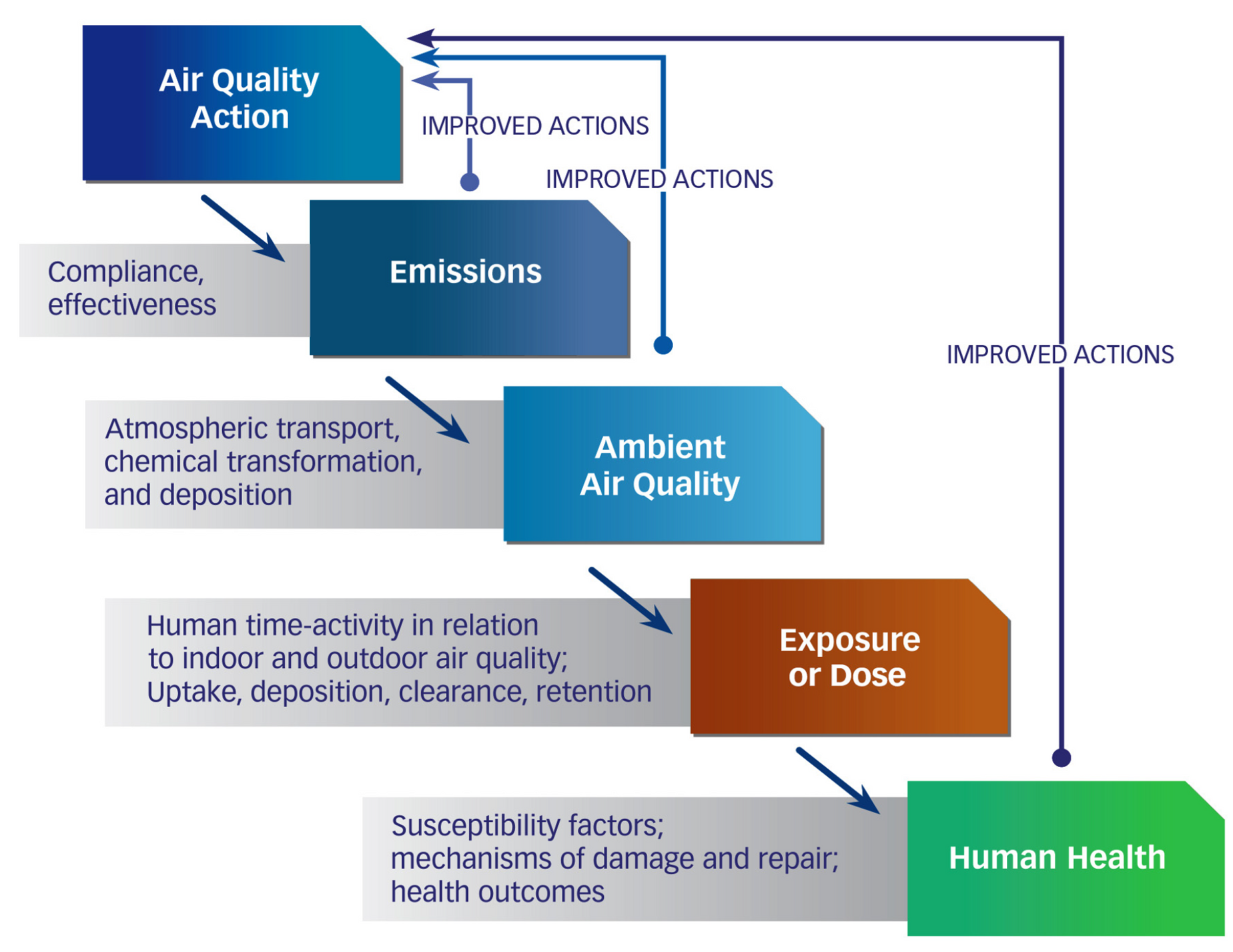
In 2003, HEI developed a conceptual framework for air quality accountability research, illustrating the chain of accountability from air quality actions to human health. This framework has helped identify where knowledge from accountability research can be applied to guide future air quality actions.
In 2003, HEI developed a conceptual framework for air quality accountability research, illustrating the chain of accountability from air quality actions to human health. This framework has helped identify where knowledge from accountability research can be applied to guide future air quality actions.
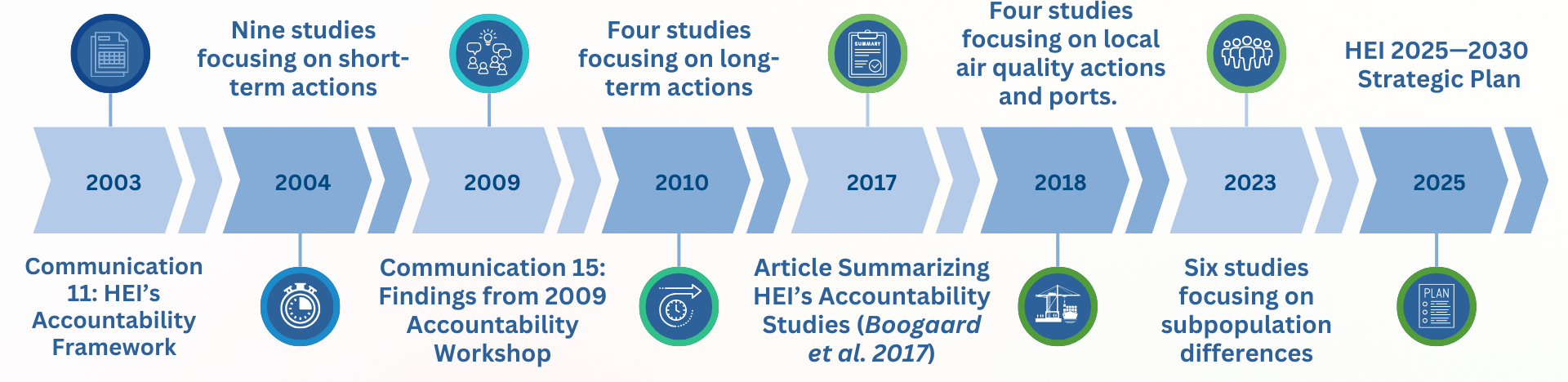
Since developing the conceptual framework, HEI has funded multiple rounds of accountability studies in the United States and beyond. The timeline below illustrates this history that has led to the current focus areas of research
Other investigators have built on the accountability work by describing additional complexities, factors, datasets, and approaches to conducting air pollution accountability studies not previously considered (Ebelt et al. 2023; Henneman et al. 2017; Rich 2018).
Other investigators have built on the accountability work by describing additional complexities, factors, datasets, and approaches to conducting air pollution accountability studies not previously considered (Ebelt et al. 2023; Henneman et al. 2017; Rich 2018).
Accountability Studies in Action — How Can These Studies Have Tangible Impacts?
HEI has published 23 accountability studies to date. The following highlighted studies represent a range of investigated actions:
Replacing diesel-powered school buses in the US
- Regulatory action: In 2021, the US Environmental Protection Agency (EPA) implemented a pilot School Bus Rebate Program with the goal of replacing old diesel school buses with new, lower-emission buses.
- Accountability study findings: In 2024, an HEI accountability study found that replacing older diesel-powered school buses resulted in improvements in school attendance and educational achievement of children, with the largest benefits for the replacement of the oldest (i.e., pre-1990) diesel school buses.
- Impact: The HEI study was used in the EPA’s third and fourth Clean School Bus reports to Congress. In the fourth report, they highlighted the need to replace older diesel buses as early as possible.
Low emission zones
- Regulatory action: In 2008, the city of London, England, implemented the London Low Emission Zone (LEZ), restricting entry of older, more polluting vehicles into Greater London.
- Accountability study findings: The study involved conducting emissions and exposure modeling to estimate the projected effects of the LEZ implementation. The investigators found that the analytical infrastructure needed to be improved to be able to study air quality effects sufficiently and provided a plan to do so.
- Impact: Transport for London enhanced existing monitoring sites by adding additional equipment and established a completely new site placed at a roadside location where the impacts of the Zone are likely to be most visible. Since the study, numerous datasets have been linked to the resulting measurements, leading to evidence linking many disease endpoints with air quality and traffic data. The study led to important lessons that laid the groundwork for further traffic emission reduction policies in London, like the Ultra Low Emission Zone implemented in 2019.
Explore these studies along with an additional selection of highlighted work in the StoryMap below.
Strengthening Accountability Research for Increased Impact
The value of accountability studies to understand the targeted ways that we can track and enhance the effectiveness of environmental policies, regulations, and interventions for public health improvements cannot be overstated. This unique research approach is of ever-increasing interest, and HEI plans to continue its efforts to contribute. As technologies and fuels continue to change, the vehicle fleet turns over, and mobility transforms, HEI is committed to supporting the most relevant research to inform decision-making and to meet the current moment. Upcoming plans for HEI’s accountability research are outlined in our 2025-2030 Strategic Research Plan.
Read more about the history of accountability studies at HEI in our in-depth exploration.
References
Boogaard H, van Erp AM, Walker KD, Shaikh R. 2017. Accountability studies on air pollution and health: the HEI experience. Curr Environ Health Rep4:514–522, https://doi.org/10.1007/s40572-017-0161-0.
Ebelt S, Baxter L, Erickson HS, Henneman LRF, Lange S, Luben TJ, et al. 2023. Air pollution accountability research: moving from a chain to a web. Glob Epidemiol 6:100128, https://doi.org/10.1016/j.gloepi.2023.100128.
HEI Accountability Working Group. 2003. Assessing Health Impact of Air Quality Regulations: Concepts and Methods for Accountability Research. Communication 11. Health Effects Institute: Boston, MA.
Health Effects Institute. 2010. Proceedings of an HEI Workshop on Further Research to Assess the Health Impacts of Actions Taken to Improve Air Quality. Communication 15. Health Effects Institute: Boston, MA.
Henneman LRF, Liu C, Mulholland JA, Russell AG. 2017. Evaluating the effectiveness of air quality regulations: a review of accountability studies and frameworks. J Air Waste Manage Assoc 67:144–172, https://doi.org/10.1080/10962247.2016.1242518.
Rich DQ. 2017. Accountability studies of air pollution and health effects: lessons learned and recommendations for future natural experiment opportunities. Environ Int 100:62–78, https://doi.org/10.1016/j.envint.2016.12.019.
