
You are here
Global Health Program
Air pollution affects millions of people around the world. Each year, exposure to air pollution is linked to the deaths of more than 6.7 million people worldwide, from a variety of health effects including respiratory diseases, cardiovascular diseases, diabetes, and neonatal disorders.
HEI’s Global Health program is engaged in projects around the world, applying science to better understand the health impacts of air pollution. The program receives financial support from foundations, philanthropies, and international organizations.
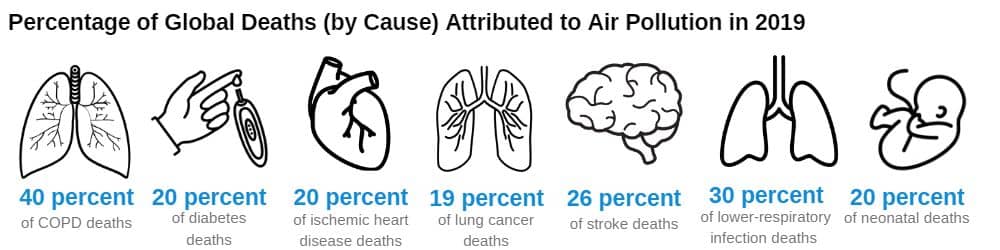
Nine out of ten people on Earth are exposed to harmful levels of PM2.5 pollution, with the highest exposures occurring in Asia, Africa, and the Middle East.
Ongoing Projects
The State of Global Air is a research and outreach initiative to provide reliable, meaningful information about air quality and health impacts around the world. A collaboration between the Health Effects Institute and the Institute for Health Metrics and Evaluation’s Global Burden of Disease study, the initiative provides the public, journalists, policymakers, and scientists access to high-quality, objective information about air pollution exposure and its health impacts. All data, reports, and resources are available to the public for free. This work is supported by the Clean Air Fund. Learn more about State of Global Air.
We work with collaborators, especially in Kenya and Uganda, to ensure that credible evidence on the health impacts of air pollution is better communicated and understood at a pacts of air pollution is better communicated and understood at a local level. To facilitate transformation towards cleaner air, the program focusses on three key strategic interventions: (i) research and synthesis of available evidence, (ii) building and expanding networks, and (iii) strengthening and expanding technical capacity across the region. This work is supported by the Clean Air Fund.
- We maintain an interactive literature database on air pollution and health, and are undertaking a scoping review on the topic.
- In March 2023, we co-organized a workshop on air pollution and health in East Africa in partnership with the Stockholm Environment Institute–Africa Centre (SEI Africa), World Resources Institute (WRI Africa), Eastern Africa GEO Health Hub (Kenya), and AirQo.
- We also ran a webinar series between September 2023 to January 2024, to foster engagement, collaboration, learning and peer-exchange in relation to research and policy on air quality and health in East Africa.
- A scoping review on air pollution and health is currently underway.
Air pollution in South Asia continues to be high, and in 2019 alone, resulted in an estimated two million deaths. HEI is working with an expert panel to conduct a scientific assessment of the changes in air quality in Indian cities as a result of the National Clean Air Programme (NCAP). This work is supported by Open Philanthropy. HEI is also supporting a national research network focused on air pollution and health effects research in India ― the Collaborative on Air Pollution and Health Effects Research (CAPHER-India). The network secretariat is led by the All India Institute of Medical Sciences (AIIMS), New Delhi and the Indian Institute of Technology Delhi (IIT-Delhi). This project is supported by the Children’s Investment Fund Foundation. The network is now being expanded to include other South Asian countries.
In Europe, HEI has funded various epidemiological studies on the health effects of traffic-related air pollution and noise and on health effects at low exposure concentrations. In May 2023, HEI co-organized a meeting in Brussels alongside the International Society for Environmental Epidemiology (ISEE), the European Respiratory Society (ERS), and the European Commission to discuss recently proposed revisions to the EU Ambient Air Quality Directive (AAQD). Our air pollution and health program is currently funding several research studies of air pollution, traffic, and health in Europe.
Past Projects
For decades, fine particulate matter (PM2.5) levels in the countries of Southeast Europe have remained higher than in other European countries. HEI worked to increase understanding of air pollution and health effects in Southeast Europe with a particular focus on Bulgaria and Serbia. We collaborated with regional experts to gather and synthesize local evidence on health effects, including national, regional, and global air pollution impacts, sources, disease burden, and critical knowledge gaps limiting policy action. This project was supported by the Clean Air Fund. More.
In 2014, HEI initiated the Global Burden of Disease from Major Air Pollution Sources (GBD MAPS) project. Using the GBD framework, investigators for GBD MAPS have estimated the burden of disease attributable to major ambient air pollution sources in countries around the world. So far, we have published three reports under this initiative. This work was supported by Bloomberg Philanthropies. More.
Watch a short video highlighting the connections among air quality, climate, and health.
HEI worked with a team of investigators from Fudan, Tsinghua Universities, and other Chinese research institutions to conduct a comprehensive analysis of emissions from shipping and related health impacts. Estimates were also prepared for the year 2030 under three future emissions control scenarios (see Special Report 22). This work was supported by the Bloomberg Philanthropies.
In 2018 and 2019, HEI evaluated the contribution of household air pollution to ambient fine particle air pollution in Ghana as well as its impact on health (see HEI Communication 19). This project was supported by the Bloomberg Philanthropies.
In 2018, HEI published a critical assessment of the state of the science examining the linkages between household air pollution formed by the burning of solid fuels and noncommunicable diseases (see HEI Communication 18). This project was supported by the Bloomberg Philanthropies.
In the 2000s, with support from foundations, HEI conducted the Public Health and Air Pollution in Asia (PAPA) program (see our coordinated studies in four cities and a comprehensive review of the Asian literature on air pollution and health). The PAPA program sought to inform regional decisions about improving air quality in Asia and was supported by a consortium of funders including the Hewlett Foundation and USAID. More.
